Web Designing

Web Development

Demand rises for web designers knowing JAVA, Cloud, HTML

With an increase in digital businesses and consumers going online in a post-pandemic world, the need to improve the quality of websites has become important. United Nations Conference on Trade and Development (UNCTAD) highlights exponential e-commerce growth in developing countries. To offer a better user interface (UI) and user experiences (UX) there is a need for web developers and designers. According to an internship and training platform Internshala, enrolments in web development course has also increased by 230% from 2017 to 2021. Other than private firms, web designers, developers are also recruited by government organisations including police departments. Recently Haryana Police advertised for the post of web designers.

Sujit Kumar Chakrabarti, associate professor, IIIT Bangalore says a large portion of web traffic comes through mobile phones. “Increasing penetration of smartphones has increased the demand for responsive websites for all devices. This has led to an increase in demand for those who have expertise in web designing and development,” says Chakrabarti. He advises students willing to opt for this as a career option and also improve the fundamental knowledge of software design, engineering principles.

Priti Gangwar, chief operating officer, Arena Animation, Preet Vihar, New Delhi, says students are taking up animation, web development, VFX and gaming among other courses as the job demand has increased.

“Students from Tier II and III cities are enrolling in a web designing course. Many of them lack proper information and need to be counselled well to help choose the right course,” says Gangwar. She adds that this field has immense career opportunities to offer as a VFS designer, 3D lighting artist, animator, motion graphic designer to name a few, but most students are not aware.

Popular among workforce

“We operate in times where technology is overshadowing every industry, pushing the workforce towards the need to acquire new in-demand skills and adapt to future jobs. Programming languages such as Java, Python, C/C++, etc. will continue to dominate the job spaces, as employers are constantly scouting for professionals who can quickly adapt to the dynamic technology terrain,” says Mayank Kumar, MD, upGrad.

Talking about the trends, Kumar says that software development vertical – which includes online courses around Java, OODAP, DSA, JavaScript, HTML5, CSS3, JavaScript, MERN, AWS, SQL & NoSQL etc. along with Cloud Native specialisation, is getting popular among the current workforce. “We have seen 120% increased intent in enrollment for our software development programmes in 2021 as compared to the previous year. Such growing numbers are also indicative of the industry demands. Therefore, the demand will only increase from here and there is a life-long learning era upon us that will require professionals to quickly adapt to the evolving circumstances for maximizing the business growth,” adds Kumar.

Shakun Bansal, VP & head – Marketing and Growth at Mercer|Mettl says, “People with knowledge of programming languages such as HTML, JavaScript etc are needed to work as the content coder and backend coder to create beautiful content and interfaces of the apps and websites.”

Additionally, candidates with expertise in programming languages says Arjun Nair, co- founder, Great Learning, are hired for roles like software engineers, full stack engineers, backend engineers, graduate engineer trainee, member of technical staff, software developer, programmer analyst, quality analyst, database administrator, production support engineer.

“Startups, MNCs, financial organisations, consulting companies and government bodies, are all in search for experts in full stack web development. Freshers and early-stage professionals aspiring for a career in this domain, require industry-relevant skills to bag these jobs. Unsurprisingly, upskilling has proven to be the best path to enable them to power ahead in their careers,” says Nair.
Jobs, skills that will be in demand in 2022

Technological advancements in business operations have brought about reforms across sectors with the implementation of several measures to adapt to the needs of the digital age. The introduction of technology within organizations has caused delays in expansion plans and the launch of new services due to a lack of experienced, skilled, and talented personnel.

While technologies like artificial intelligence, machine learning, and data analytics will bring about a fundamental change to meet the requirements in the coming decades, the pandemic has accelerated their implementation, causing several digital disruptions to ensure continuity across sectors. These changes have resulted in a demand for skilled professionals across various domains. The rapid advancements made by technology will drive shifts in the job market.

Businesses have had to pivot and change their operational processes in order to survive and thrive, necessitating a large portion of the workforce to learn new skills. According to the World Economic Forum, 65 percent of children entering primary school will be employed in jobs that are currently unheard of. Google’s recent decision to launch their new Google Cloud Skills program, which aims to train 40 million people, reflects their initiative to evolve with changing times and prepare learners for the future job market. Therefore, upskilling and reskilling will improve employment prospects, and learners who stay updated with modern learning will advance in their careers.

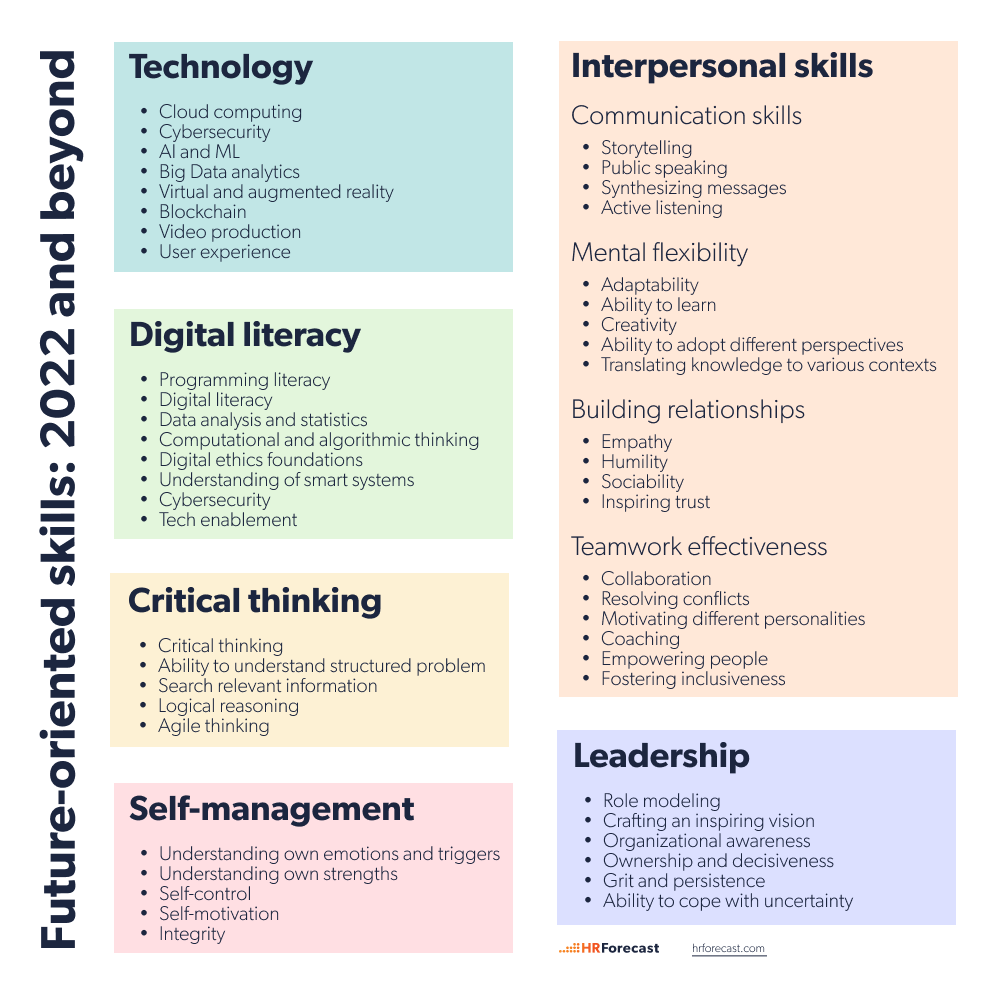
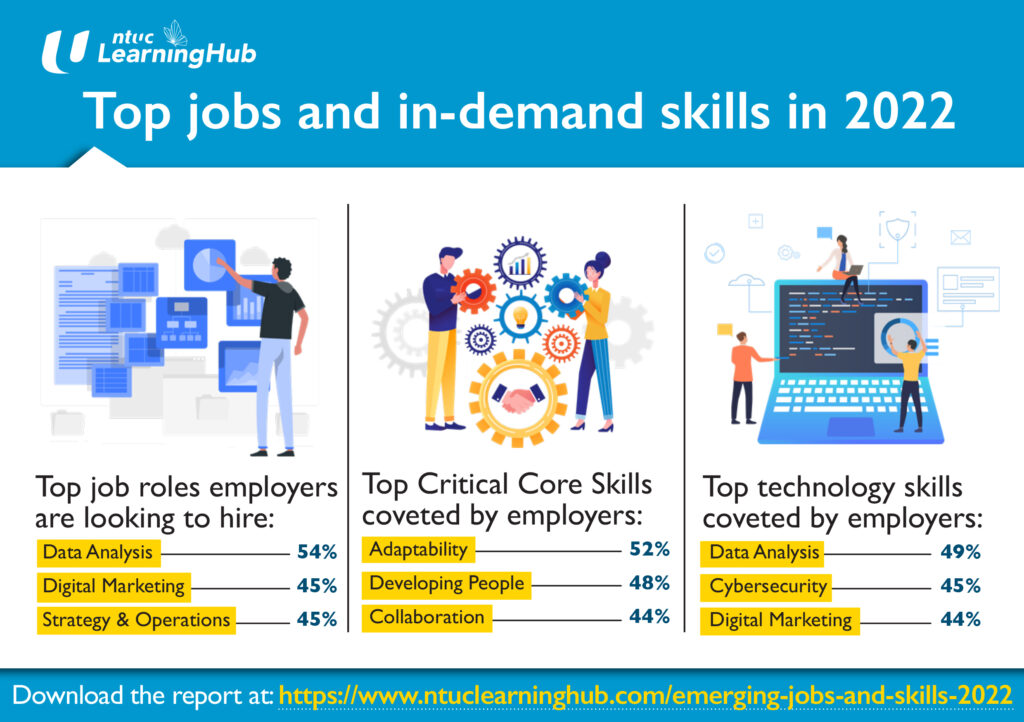
To ensure that learners are gainfully employed across various sectors, we have identified skills that are projected to be in demand in 2022.

Data Science:
Data has become crucial for businesses, and worldwide data is expected to exceed 149 zettabytes by 2024, up from just two zettabytes a decade ago. Industries will require trained professionals who can extract useful information from this vast amount of data. Businesses will increasingly rely on relevant and valuable insights derived from data to enhance the consumer experience and gain a competitive edge. Therefore, data scientists will be highly sought-after professionals in the next decade. Currently, skilled professionals in this field are scarce, and organizations are willing to offer higher salaries to attract them. Aspiring data scientists should focus on learning computer languages, advanced analytics, and refining their statistical and data mining skills.

Machine Learning:
Machine learning, a subset of artificial intelligence, has become one of the most desirable skills in the technology field. As companies adopt automation tools to anticipate consumer needs, the demand for machine learning professionals will significantly increase. The Wall Street Journal has previously reported that job postings for AI professionals in the U.S. nearly doubled between November 2020 and March 2021. Data scientists and machine learning professionals have overlapping roles, as both work with large datasets. While data scientists extract valuable insights from vast amounts of data, machine learning scientists ensure that the models and simulations used by data scientists are accurate and can analyze massive amounts of data in real time. The intersection of these fields leads to results that were previously unthinkable. Professionals who acquire skills in either of these fields will greatly benefit during the recruitment process.

Full-Stack Coding:
The demand for full-stack coders is increasing as companies seek skilled computer programmers who can handle both the front and back end of development. Full-stack experts work as web developers or engineers, responsible for building user interfaces, collaborating with clients during project planning, and participating in every phase of development. As a result, the demand for these professionals is high. According to employment website Indeed, full-stack developer jobs ranked second on the list of Best Jobs of 2020, and their popularity continues to grow due to the increasing presence of software and applications in our digitally connected world. Those interested in pursuing a career in this field should possess excellent attention to detail and strong organizational skills.

As our economies and industries embrace a tech-driven future, these skills will be in high demand. Cybersecurity, robotics, cloud computing, blockchain, AR and VR, and related fields are on the brink of a boom. The common thread connecting these trends is the eventual necessity of technology-based skills across all industries. For example, today’s engineers, regardless of their specialization in mechanical or civil engineering, are expected to have coding knowledge. This push towards programming is even reflected in the New Education Policy 2020, which includes coding as a skill to be taught in schools.

Employers now assess candidates’ employability based on their skill sets, including the core skills required for a job role as well as additional abilities they bring to the table. An engineer who can effectively leverage their coding skills will be highly employable and valuable across teams.